


Singaporebrides | Editors' Notes
June 2026
The Big and Beautiful Indian Wedding, From The Subcontinent to the Sunny Island

We speak with Vogue India’s Rochelle Pinto about why the big and modern Indian wedding is for everyone, and why the best celebrations have never been about the money.
If you’ve ever been to an Indian wedding in Singapore, you already know you’re in for a visual and aural treat. After feasting, the aunties who’ve flown in from three different countries will absolutely be on the dance floor if you had one. There is something about an Indian wedding, the layering of ritual and colour and noise and feeling, that tends to stay with people long after the last plate of biryani has been eaten.
Singapore’s Indian community is not a monolith, and it never has been. The majority are Tamil-speaking South Indians, largely descended from those who came to the island during the British colonial era, whose weddings are steeped in Dravidian custom: the thali tied at the altar, the nadaswaram filling the mandap, the bride in her Kanjivaram silk. But there is also a significant Punjabi diaspora, Sikhs whose families put down roots here generations ago and whose celebrations carry the distinct flavour of North India, the anand karaj conducted at the gurdwara, the dhol that starts the baraat, the phulkari dupatta worn with pride. Then there are the Malayali, Sindhi and Bengali communities, each bringing their own languages, rituals and aesthetics to the table. To speak of the “Indian wedding in Singapore” is really to speak of many weddings, many traditions, and many ways of belonging.
 Image from Praneetha and Amar’s Colourful Temple Wedding at Perumal Temple by Subra Govinda Photography
What most of them share, though, is the particular experience of celebrating a culture from a little bit of a distance. The majority of Singapore Indians are second, third, sometimes fourth generation. They grew up code-switching—Tamil at home, English at school, maybe Mandarin with their neighbours. They know what their traditions feel like, even when they can’t always explain why. And when it comes to weddings, they are increasingly asking a question that their parents’ generation perhaps didn’t feel they had the right to ask: can I make my wedding mine, in my own way?
That question is exactly what Rochelle Pinto, Head of Editorial Content at Vogue India, has been watching play out across India and across its diaspora. Last month, she came to Singapore for Vogue India’s Evening with the Editor, an intimate gathering that marked the publication’s first time in the city. She shares with us what the modern Indian wedding is actually becoming, what the Vogue Wedding Atelier is setting in motion, and what she would say to the bride here who loves everything about her heritage—and is still figuring out how to make it fit.
ON THE MODERN INDIAN WEDDING
The Indian wedding has always been a grand affair, but you’ve spoken about a shift towards more personalised, design-led celebrations. What’s actually driving that change?
Rochelle: At the heart of every celebration is the couple and their family, they have lit the spark of a new mindset. People want to spend their money and time wisely, creating moments that they will remember and treasure forever because it is becoming increasingly rare to have all the people you love in one geographical location. Frittering away that opportunity on OTT spectacle for the sake of spectacle is a telling sign of herd mentality.
 Vogue Wedding Atelier
How has the conversation around Indian bridal fashion changed in the last five years? Are brides arriving with more confidence in their own taste, or are they still largely deferring to family tradition?
Rochelle: Brides are demanding customisation and one-of-a-kind storytelling more than ever before. They are proud of their heritage and want to use their wedding day to showcase that connection, but many choose to do so in a way that feels unique to them. Whether that is incorporating their grandmother’s sari border into a modern lehenga or pairing heirloom jewellery with a couture gown for a cocktail party or even designing a statement necklace that repurposes jewels inherited from their mothers, brides are firmly in their main character era.
There’s a lot of pressure on Indian brides to look a certain way—maximalist, heavily embellished, picture-perfect. Is Vogue India pushing back on that aesthetic at all, or celebrating it?
Rochelle: Vogue India celebrates creativity and purpose—who is to say what is maximalist and what is minimalist? These terms betray a colonial mindset and I firmly reject them. India is such a diverse country with wonderfully rich traditions that to try and squeeze this melange into two ill-fitting boxes feels racist.
 Vogue Wedding Atelier
ON THE DIASPORA BRIDE
A significant part of your global readership is Indian diaspora, including here in Singapore, where Indian brides are often second or third-generation, navigating heritage alongside very local, multicultural realities. How does Vogue India speak to that reader, who loves the tradition but isn’t living it in the same way?
Rochelle: Most women today, no matter where they live, are citizens of the world. Many of the brides we encounter have lived in many different cities, have friends from different cultures, are well-travelled and so, their taste and choices reflect these influences. What we will continue to do is give women all the inspiration they need to craft a celebration that is distinctly theirs and encourage them to be bold in their choices.
When a Singaporean Indian bride looks at Indian bridal content, she might feel the pull of the aesthetic but not necessarily the cultural context behind it. What would you say to her about how to make Indian bridal fashion feel authentically hers, rather than borrowed?
Rochelle: I would say what I say to everyone who is finding themselves—give yourself the grace to experiment, make mistakes, discover something new about yourself that even you did not see coming. At the end of the day, these will all seem trivial in comparison to feeling loved and celebrated by the people who care for you the most.
Do you see diaspora communities influencing Indian bridal trends in return?
Rochelle: Inspiration is everywhere, I don’t subscribe to didactic philosophies. Often, the most incredibly influential moments of our lives are completely serendipitous, there is great joy and opportunity in keeping an open mind.
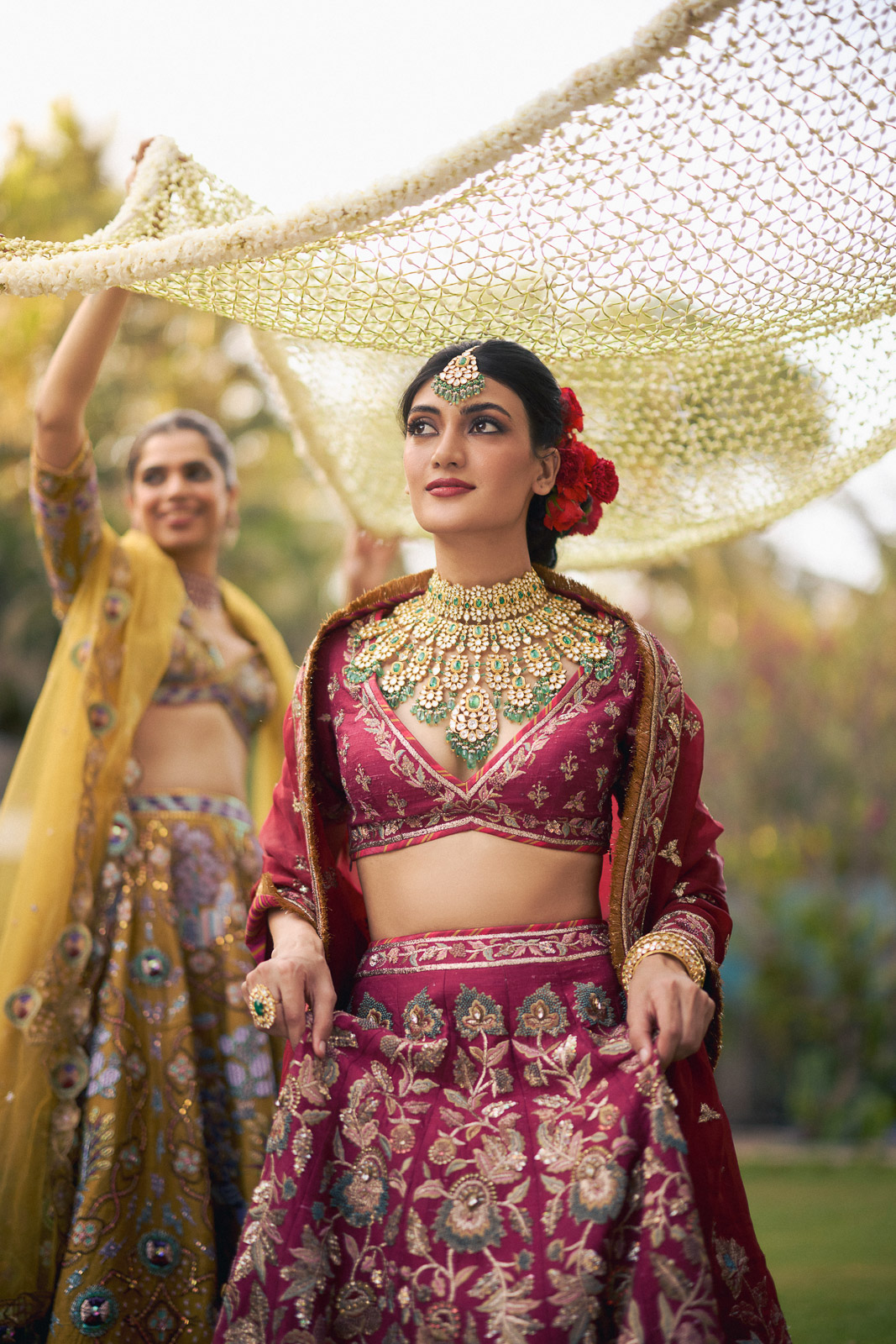 Vogue Wedding Atelier
ON THE VOGUE WEDDING ATELIER
If the Evening with the Editor was an introduction, the Vogue Wedding Atelier is the main event. Launched in 2025 at the iconic Taj Palace in New Delhi, it was Vogue India’s most ambitious step yet beyond the page: an invite-only, three-day immersive bringing together India’s leading bridal couture designers, high jewellery houses, beauty experts and bespoke luxury services all under one roof.
The Vogue Wedding Atelier feels like a significant shift, from editorial coverage to an immersive, experiential format. What led to its launch, and what were you hoping it would do that a magazine spread couldn’t?
Rochelle: Being able to deliver a high-quality immersive experience that goes beyond the pages of a magazine but actually allows a Vogue loyalist to see for themselves what magic we are capable of creating. Craft, especially of the finesse that India delivers to the world, needs to be seen, touched and absorbed in the flesh.
The event brings together big designer names alongside high jewellery houses and beauty brands. How did you think about curation? What made the cut, and what didn’t?
Rochelle: We only make room for the best of the best, while keeping diversity and representation top of mind.
What was the one moment or conversation from the Atelier that genuinely surprised you?
Rochelle: How excited people are about Indian craft, how they travel from all over the world to experience it up close and make it their own.
 Vogue Wedding Atelier
ON OWNING YOUR OWN WEDDING
For a bride on a more modest budget who still wants to engage with Indian bridal aesthetics thoughtfully, what’s your advice?
Rochelle: The idea that good taste is gatekept by wealth is something I have never understood. Especially in a country with as many skilled artisans as ours. A modest budget should actually lead to a more sustainable, personalised celebration. Buying fabrics from the makers directly and working with a local master to create your wedding look, eschewing wasteful and elaborate sets and 100-dish-buffets in favour of homegrown crafts and cuisine, whittling down your guestlist to the ones who really matter and choosing an intimate location that has meaning to you rather than one that features on some 50 Best list somewhere—the examples are endless.
One of my favourite “celebrity” weddings took place on the terrace of the couple’s home and the bride wore a simple red silk sari, getting ready in her bedroom. Sifting through the photos, we couldn’t find a single one where the bride, groom and the guests were not glowing with positive vibes. It went viral for all the right reasons.
 Rochelle Pinto, Vogue India
The Vogue Wedding Atelier returns to the Taj Palace, New Delhi from 7–9 August 2026. This invite-only experience brings together the country’s leading bridal couture designers, high jewellery brands, experts and bespoke luxury services, all under one roof.
Image credit: Feature image from Praneetha and Amar’s Colourful Temple Wedding at Perumal Temple by Subra Govinda Photography
All content from this article, including images, cannot be reproduced without credits or written permission from SingaporeBrides.
Follow us on Instagram, Telegram, and TikTok for the latest article and promotion updates!